Let Them Get Dirty: The Surprising Science Behind Mud Puddle Play
If your little one has ever watched Peppa Pig — and let's be honest, whose kid hasn't? — they've seen Peppa and George leap gleefully into muddy puddles with zero hesitation and maximum joy. And if your child has ever looked up at you afterward with those big hopeful eyes, pointing at the nearest rain-soaked patch of yard, you already know the internal struggle that follows.
Do you let them? Or do you steer them toward the sidewalk and save your laundry?
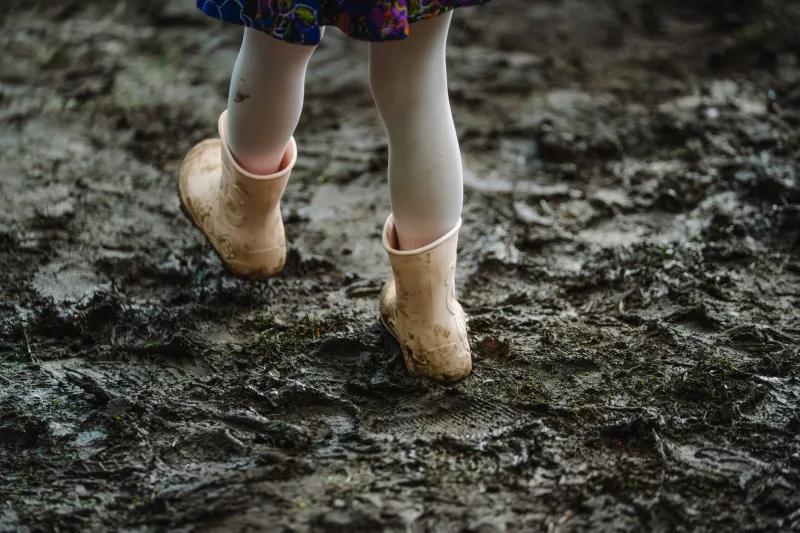
Here's the thing: the research is pretty firmly on Peppa's side. Messy, unstructured outdoor play — mud puddles included — is one of the most valuable things a young child can experience. So before you redirect those little Wellington boots away from the nearest puddle, let's talk about why you might actually want to point them toward it.
What Happens in a Child's Brain During Messy Play
When kids squish mud between their fingers, splash through puddles, or dig up a patch of dirt in the backyard, they're not just making a mess. They're doing serious cognitive work.
Sensory play — any activity that engages a child's senses of touch, smell, sight, and sound — directly stimulates neural pathways in the developing brain. According to early childhood education experts, these pathways support language development, problem-solving, and even emotional regulation. Every time your toddler pats a mud pie flat or watches ripples spread across a puddle, their brain is building connections that more structured activities simply can't replicate in the same way.
Dr. Stuart Brown, a leading researcher in play science and founder of the National Institute for Play, has spent decades studying how unstructured play shapes human development. His findings consistently show that children who engage in free, exploratory play develop stronger executive function skills — things like planning, flexibility, and impulse control — than those whose time is heavily scheduled and supervised.
In other words, the chaos of outdoor messy play is actually building order inside your child's mind.
The Mud Puddle as a Sensory Classroom
Think about everything a child experiences when they jump into a puddle. The cold splash on their legs. The squelching sound underfoot. The way the mud changes color when it's wet versus when it starts to dry. The smell of rain on earth (which, fun fact, has an actual name — petrichor — and research suggests it's deeply calming to the human nervous system).
All of that sensory input is rich, varied, and completely self-directed. Your child is choosing what to explore, how long to explore it, and what to do next. That autonomy is hugely important.
Occupational therapists who work with children often use sensory play deliberately as a therapeutic tool — particularly for kids who struggle with sensory processing challenges. But even for neurotypical children, regular exposure to varied textures and environments helps build what's called sensory tolerance, making them more adaptable and less easily overwhelmed as they grow.
Peppa's world celebrates this instinctively. There's no hand-wringing in the Pig household about muddy boots — Mommy Pig and Daddy Pig just laugh along. And while real life obviously involves a little more laundry logistics than a cartoon, the underlying attitude is worth borrowing.
But What About the Mess? (Let's Address the Elephant in the Room)
Okay, real talk: messy play is wonderful in theory and deeply inconvenient in practice. You have to deal with muddy clothes, dirty hands, potentially muddy cars, and the guaranteed bath that follows. If you're running on limited time — which, as a parent, you always are — the cleanup overhead can feel like it outweighs the benefit.
Here are a few practical strategies that parents swear by:
Designate a "mud zone." Pick a specific area of your yard or outdoor space where messy play is fully allowed. A corner of the garden, a patch near the hose, or even a plastic kiddie pool filled with a little dirt and water works great. When kids know there's a place where mess is welcome, they're less likely to bring it everywhere else.
Invest in dedicated outdoor gear. A set of cheap waterproof rain pants, a splash suit (widely available at Target, Amazon, and Walmart), and a pair of rubber boots designated just for outdoor play can completely change your stress level. When the mess-proof outfit goes on, everything that happens next is fair game.
Keep the hose handy. A quick rinse before coming inside removes the bulk of the mess in minutes. Pair it with a basket by the back door for muddy shoes and jackets, and you've created a natural decontamination zone that keeps the chaos outside where it belongs.
Reframe your expectations. This one's more mental than logistical, but it matters. If you go into outdoor play expecting perfection, you'll spend the whole time anxious. If you go in expecting mud — because there will be mud — you can actually enjoy watching your kid light up.
The Immunity Angle (Yes, Really)
Here's a bonus benefit that might tip the scales for more hesitant parents: the "hygiene hypothesis." This is the widely studied idea that early childhood exposure to natural environments, including soil and the microorganisms that live in it, actually helps train and strengthen the immune system.
Researchers at institutions like the University of Helsinki have found that children who play in natural, biodiverse outdoor environments tend to have more diverse gut microbiomes and stronger immune responses than those raised in highly sanitized settings. Now, this doesn't mean letting your kid eat handfuls of dirt — basic hygiene still applies. But it does suggest that a reasonable amount of outdoor grime is genuinely good for your child's long-term health.
Peppa jumping in muddy puddles? Turns out that might be the healthiest thing she does all episode.
Making Messy Play a Regular Habit
You don't need a rainstorm to get the benefits of sensory outdoor play. Here are a few easy ways to work it into your regular routine:
- After-school mud kitchen: Set up a little outdoor "kitchen" with old pots, spoons, and a patch of dirt. Kids can make "mud soup" and "mud cakes" to their hearts' content.
- Weekend puddle walks: After a rain, pull on the boots and take a deliberate puddle-jumping walk around the block. Make it an event. Peppa would.
- Sensory bins that go outside: Fill a plastic storage bin with kinetic sand, wet sand, or soil mixed with water. It's contained, it's textured, and it hits all the same developmental notes as a full mud puddle experience.
- Garden involvement: Even pulling weeds or watering plants gets little hands dirty in a purposeful way.
The goal isn't to manufacture mess for mess's sake — it's to give your child permission to interact with the physical world in an unfiltered, self-directed way. That's where the magic happens.
A Little Mud Goes a Long Way
At the end of the day, Peppa Pig's love of muddy puddles isn't just a cute character quirk. It's a pretty accurate reflection of what young children are naturally drawn to — and for good reason. Outdoor, sensory, unstructured play is one of the most developmentally rich experiences you can offer your child, and it costs absolutely nothing.
So the next time you're walking past a puddle and your little one looks up at you with that unmistakable expression of desperate hope, maybe lace up your own boots. The laundry can wait. The moment won't.